Home / Shoulder & Elbow
Shoulder & Elbow Surgery
Double fellowship-trained in Manchester and North Tees, with a travelling fellowship at the Mayo Clinic, one of the world’s leading centres for shoulder and elbow reconstruction.
Most shoulders do not need an operation
The shoulder is the most mobile joint in the body, and that mobility comes at the cost of stability. When it hurts, the cause is usually one of a small number of problems, and telling them apart properly is most of the work.
A frozen shoulder, an impinging tendon, a partial cuff tear and early arthritis can all present as “pain and stiffness”, but they need completely different treatment. Getting that diagnosis right is what prevents unnecessary surgery.
Where an operation genuinely is the answer, the aim is to do it through the smallest reasonable approach. Most reconstructive shoulder work, including cuff repairs, stabilisation, decompression and capsular release, is done arthroscopically through keyhole incisions.
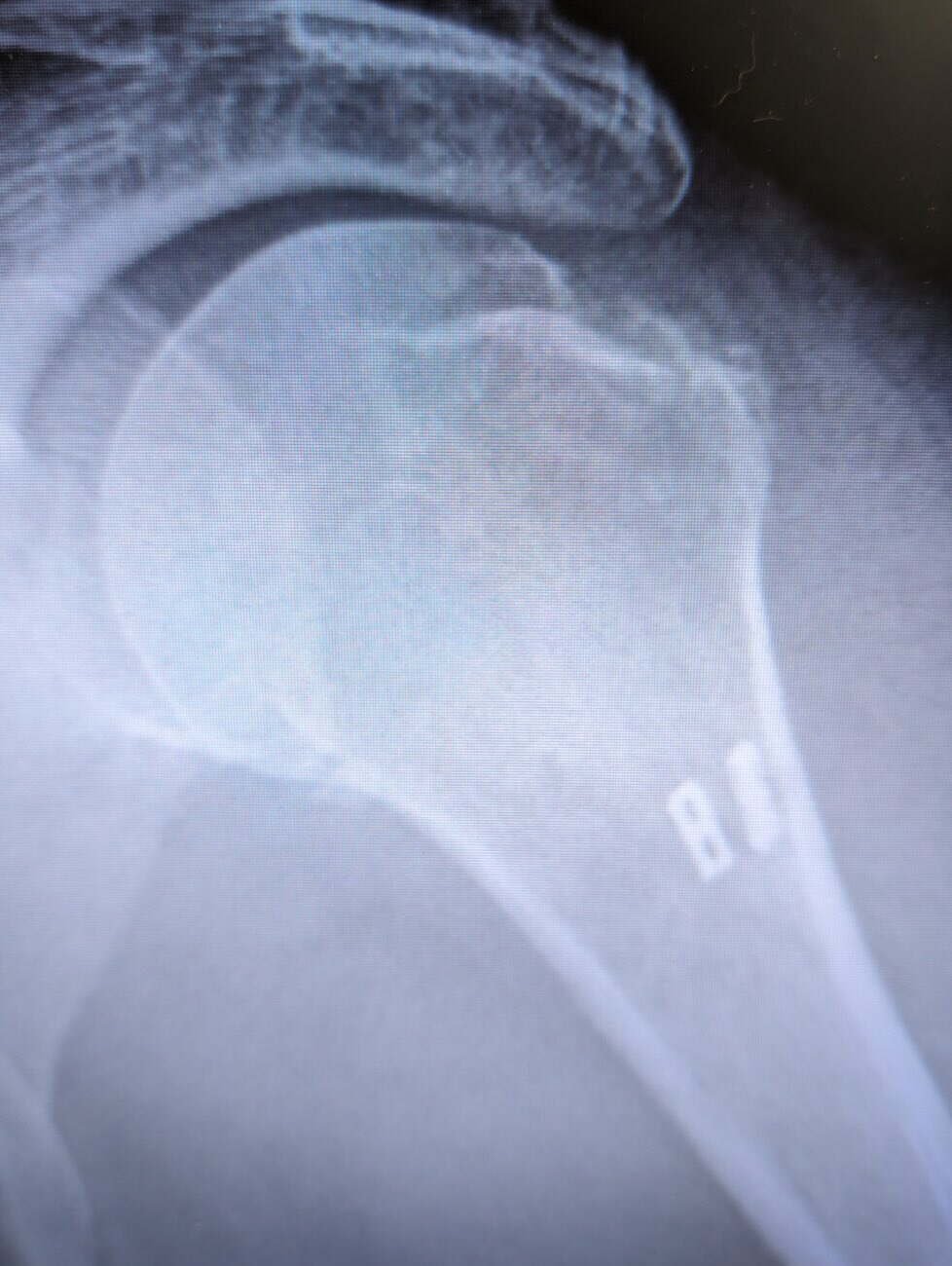
A greater tuberosity fracture held with endobuttons, fixation that restores the cuff attachment without bulky metalwork.
Shoulder conditions treated
Rotator Cuff Tears
Tears of the tendons that lift and rotate the arm, from degenerate partial tears through to large, retracted tears. Treatment ranges from targeted physiotherapy and injection to arthroscopic repair, and in irreparable cases, tendon transfer or reverse replacement.
Frozen Shoulder
Adhesive capsulitis, a painful and progressively stiff shoulder that often follows no injury at all. Most cases improve with a structured programme of injection and physiotherapy; a minority need arthroscopic capsular release.
Impingement & Bursitis
Pain on reaching overhead, caused by tendon and bursa irritation beneath the acromion. Usually managed without surgery; arthroscopic subacromial decompression is reserved for cases that do not settle.
Instability & Dislocation
Recurrent dislocation, subluxation and a shoulder that simply feels unreliable. Treated by arthroscopic labral (Bankart) repair, or by bone block procedures such as Latarjet where there is significant bone loss.
Shoulder Arthritis
Wear of the ball-and-socket joint causing deep, grinding pain and loss of rotation. Managed non-operatively for as long as it is reasonable, then by anatomic or reverse shoulder replacement.
AC Joint Problems
Pain at the top of the shoulder from acromioclavicular joint arthritis or separation following a fall onto the point of the shoulder. Treated by injection, excision or reconstruction depending on the grade.
Elbow conditions treated
The elbow is a smaller joint with less margin for error. Stiffness and nerve irritation follow quickly when it is not managed carefully.
- Tennis elbow and golfer's elbow, tendon overload at the outer or inner elbow
- Elbow stiffness and contracture, treated by arthroscopic or open release
- Elbow arthritis, from arthroscopic debridement through to elbow replacement
- Ulnar nerve compression (cubital tunnel syndrome)
- Distal biceps rupture, repair of the tendon at the elbow
- Elbow fractures and their complications, including radial head replacement
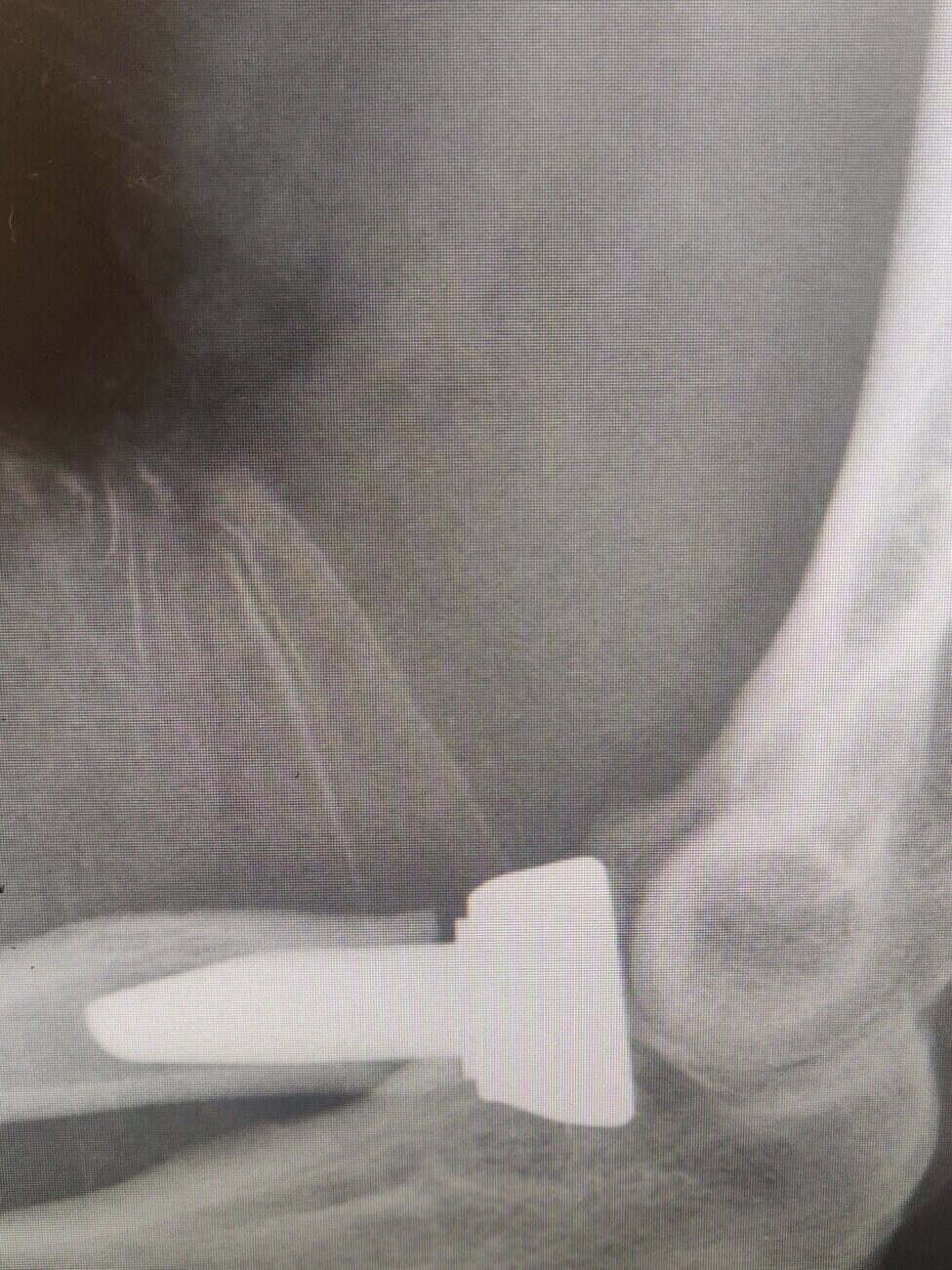
Radial head replacement following a terrible triad injury of the elbow.
Shoulder & elbow FAQs
Almost certainly not. The majority of shoulder and elbow problems seen in clinic are managed without an operation. What they need is an accurate diagnosis, a targeted injection where it is appropriate, and rehabilitation that is properly supervised. Surgery is recommended when the problem is structural, when it will not resolve on its own, or when non-operative treatment has been given a fair trial and failed.
An anatomic replacement recreates the normal architecture of the shoulder: a ball on the humerus and a socket on the glenoid. It relies on an intact, working rotator cuff.
A reverse replacement swaps that arrangement: the ball is fixed to the socket side and the cup to the humerus. This lets the deltoid muscle lift the arm even when the rotator cuff is torn or non-functional.
A repaired tendon needs time to heal to bone, and that biology cannot be rushed. Typically a sling is worn for around four to six weeks, with passive movement started early under guidance. Active strengthening usually begins around the three-month mark, and most patients see continued improvement out to nine or twelve months.
Not automatically. Arthroscopy usually means less soft-tissue disruption and a more comfortable early recovery. But some problems are done better and more reliably open, among them significant bone loss, certain revisions, and joint replacement. The approach is chosen to suit the problem.
Not necessarily. Bring whatever imaging you already have, but there is no need to arrange a scan in advance. A great deal is established from the history and a careful physical examination, and the right investigation is best chosen after that.
In most cases, yes. Frozen shoulder typically runs a long but self-limiting course. Guided injection combined with a structured physiotherapy programme relieves pain and speeds the return of movement for the majority of patients.
Get your shoulder or elbow properly assessed
A specialist consultation will tell you what is actually wrong, what your options are, and whether an operation is genuinely needed.