Home / Conditions & Treatments
Conditions & Treatments
What Dr Malik sees, and how each problem is generally approached. If your condition is not listed here, it is still worth asking.
The shoulder
Pain, weakness, stiffness or a shoulder that feels as though it might give way. Each points in a different direction diagnostically.
- Rotator cuff tear, partial and full thickness
- Rotator cuff tendinopathy
- Subacromial impingement
- Subacromial bursitis
- Frozen shoulder (adhesive capsulitis)
- Calcific tendinitis
- Recurrent shoulder dislocation
- Labral and SLAP tears
- Shoulder osteoarthritis
- Cuff tear arthropathy
- AC joint arthritis and separation
- Biceps tendon problems
- Proximal humerus fractures
- Failed previous shoulder surgery
The elbow
A joint that becomes stiff quickly and forgives very little. Early, accurate management matters more here than almost anywhere else.
- Tennis elbow (lateral epicondylitis)
- Golfer's elbow (medial epicondylitis)
- Elbow stiffness and contracture
- Elbow osteoarthritis
- Loose bodies in the elbow
- Cubital tunnel syndrome
- Distal biceps tendon rupture
- Elbow instability
- Radial head fracture
- Post-traumatic elbow reconstruction
- Olecranon bursitis
The knee
From wear-related arthritis through to the mechanical problems that make a knee lock, catch or give way.
- Knee osteoarthritis
- Single-compartment (unicompartmental) arthritis
- Meniscal tears
- Patellofemoral pain
- Knee deformity, varus and valgus
- Loose bodies and locking
- Failed or painful knee replacement
- Periprosthetic infection
The hip
Groin pain, a limp, difficulty with socks and shoes, or pain that radiates to the knee. These are all common presentations of hip disease.
- Hip osteoarthritis
- Avascular necrosis of the femoral head
- Hip dysplasia in adults
- Femoroacetabular impingement
- Trochanteric bursitis
- Inflammatory arthritis of the hip
- Failed or loose hip replacement
- Leg length discrepancy after replacement
Not everything ends in an operation
The full range of treatment considered at consultation, in roughly the order it is usually tried.
Diagnosis First
History, examination and only the imaging that will change the decision.
Rehabilitation
Structured, supervised physiotherapy with clear goals, which remains the most underused treatment in orthopaedics.
Injections
Image-guided steroid, hydrodilatation and other injections where they are genuinely indicated.
Surgery
Arthroscopic where possible, open where it is better, robotic where the precision counts.
When a scan finding is not a problem
A small proportion of shoulders are simply built differently. Instead of a rim of cartilage running the whole way round the front of the socket, the upper front portion of that rim is absent, and the ligament beneath it is thickened into a cord. This is called a Buford complex, and it is a normal variant, a way that some shoulders are made rather than something that has gone wrong.
It matters because on an MRI it looks alarming. The missing labrum reads as a tear. The thick cord reads as a detached fragment. A shoulder that has never caused its owner a moment of trouble can come back reported as having significant damage.
Getting this wrong is not harmless. Repairing a Buford complex, stitching that cord-like ligament down onto the rim of the socket, does not correct anything, because nothing was broken. What it reliably does is stiffen the shoulder and take away external rotation.
The answer is not to treat the scan. It is to examine the patient, listen to the history, and work out whether the finding actually explains the symptoms. Often it does not, and the right operation is none at all.
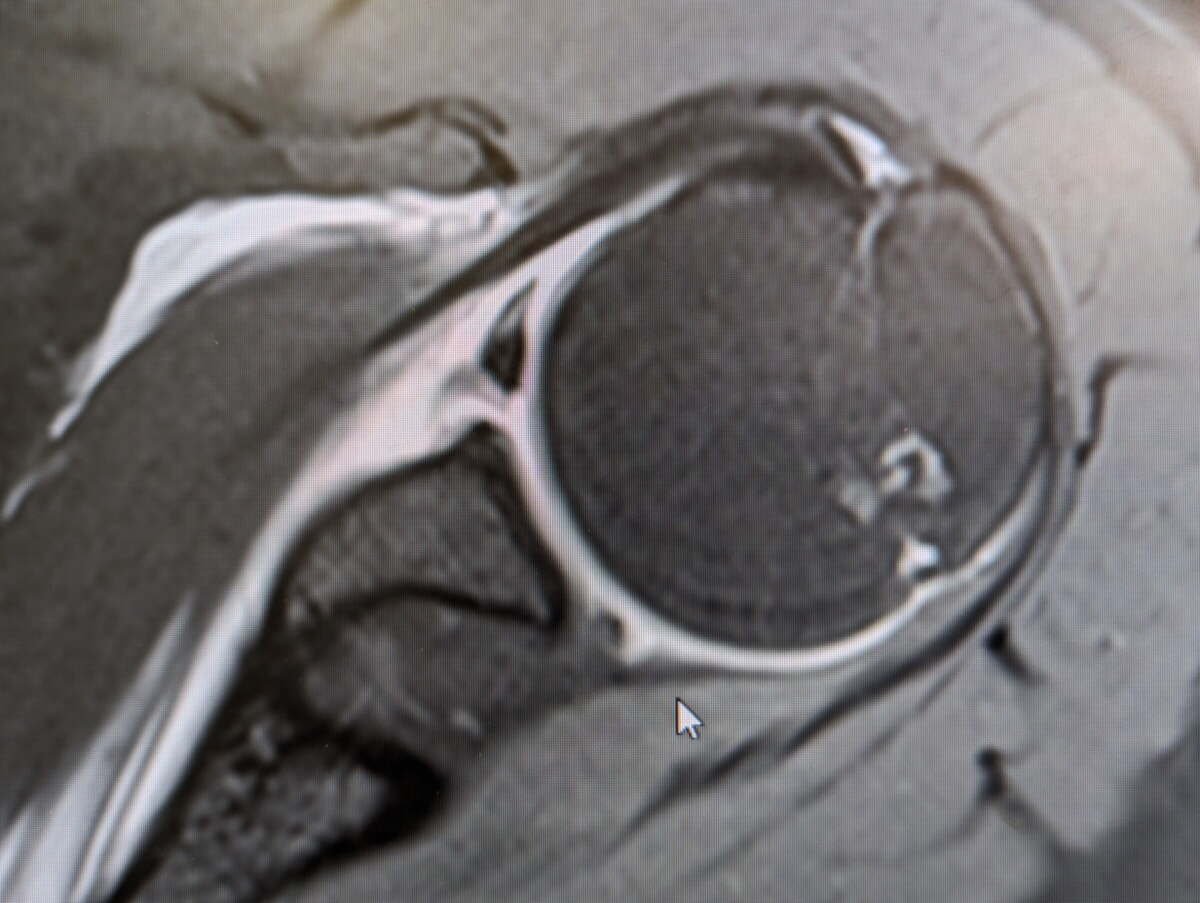
An MRI showing a Buford complex. The cord-like ligament and the absent rim at the front of the socket are the normal variant, not an injury.
Not sure which of these describes your problem?
That is exactly what a consultation is for. Bring any scans or reports you already have.