Home / Shoulder & Elbow / Anatomic Total Shoulder Replacement
Anatomic Total Shoulder Replacement
A shoulder replacement that rebuilds the shoulder’s own ball and socket, for arthritis when the rotator cuff tendons are still healthy. Because your own tendons keep working, the shoulder moves in a natural way, and many people return to the sports they enjoy.
When the joint surfaces wear out
The shoulder is a ball-and-socket joint. Both surfaces are covered in smooth cartilage, and a group of tendons called the rotator cuff holds the ball in the socket and moves it.
In osteoarthritis the cartilage wears away until bone rubs on bone. The shoulder becomes painful, often at night, and stiff, and it can grind or catch. Turning the arm outwards, and reaching behind your back or up to your head, all get harder.
A new ball and a new socket lining
When the rotator cuff is still healthy, the worn surfaces can be replaced while keeping the shoulder’s natural shape. The worn ball at the top of the arm bone is replaced with a smooth metal ball, and the socket is lined with smooth, hard-wearing plastic.
Your own tendons then move the new joint, just as they moved the old one.
When an anatomic replacement is used
Osteoarthritis with healthy cuff tendons
The commonest reason: the cartilage has worn away, but the rotator cuff is still working well.
Arthritis after an old dislocation or earlier surgery
When the cuff tendons are still healthy.
Avascular necrosis
When the bone of the ball has lost its blood supply and collapsed.
Rheumatoid and other inflammatory arthritis
When the cuff tendons are still healthy, and there is enough good bone in the socket.
It is usually offered when pain and stiffness are spoiling everyday life and sleep, and physiotherapy, painkillers and injections no longer help enough.
What the results show
Anatomic shoulder replacement has been used for decades, and is followed by national joint registries and long-term studies. This is what they show for the operation in general.
Lasting pain relief
Pain relief is the most dependable benefit, and for most people it lasts. Sleep usually improves quickly.
Natural movement
Your own tendons move the new joint, so it moves in a natural way. Most people lift the arm much higher than before, and turning it outwards and reaching behind the back improve too.
Built to last
Long-term studies show that the great majority are still in place, without further surgery, ten years after the operation, and most people still feel the benefit.
Most are pleased
The great majority of people are satisfied with the result, older people included.
Back to sport
More people return to sport after an anatomic replacement than after any other shoulder replacement, most often golf, swimming and tennis.
Back to work
Most people who were working go back to work, although heavy manual work is harder to return to.
These findings come from national joint registries and large published studies, not from one surgeon’s own results. Results are less predictable after earlier shoulder surgery, and with heavy manual work.
Anatomic or reverse, when the cuff is healthy
Both kinds of shoulder replacement can work well for arthritis when the cuff is healthy. They work in different ways, and suit different shoulders.
An anatomic replacement keeps the natural ball and socket, and your own cuff moves it. A reverse replacement swaps the ball and socket over, so that the deltoid, the large muscle over the shoulder, does the lifting.
| Anatomicthe natural shape kept | Reverseball and socket swapped | |
|---|---|---|
| How it works | Keeps the natural ball and socket | Swaps the ball and socket over |
| What moves the shoulder | Your own rotator cuff, with the deltoid | Mainly the deltoid |
| Lifting the arm | Good | Good |
| Turning outwards and reaching behind | Better | More limited |
| Return to sport | The highest of all shoulder replacements | Good, mostly gentler sports |
| Over the years | The socket lining can loosen, or the cuff can wear | Fewer repeat operations in some studies |
| Often suits | A healthy cuff, and a socket with good bone to hold a new lining | A torn or thin cuff, or a socket too worn or weak to hold a lining |
Anatomic
- How it works
- Keeps the natural ball and socket
- What moves the shoulder
- Your own rotator cuff, with the deltoid
- Lifting the arm
- Good
- Turning outwards and reaching behind
- Better
- Return to sport
- The highest of all shoulder replacements
- Over the years
- The socket lining can loosen, or the cuff can wear
- Often suits
- A healthy cuff, and a socket with good bone to hold a new lining
Reverse
- How it works
- Swaps the ball and socket over
- What moves the shoulder
- Mainly the deltoid
- Lifting the arm
- Good
- Turning outwards and reaching behind
- More limited
- Return to sport
- Good, mostly gentler sports
- Over the years
- Fewer repeat operations in some studies
- Often suits
- A torn or thin cuff, or a socket too worn or weak to hold a lining
The choice rests mainly on the health of your rotator cuff and the quality of your bone and joint, rather than your age. Dr Malik will explain which suits your shoulder, and why.
Read more about Reverse Total Shoulder Replacement.
Planned for your shoulder
Every anatomic replacement is planned from your X-rays and a CT scan, which show the shape of the socket and the quality of your bone. Dr Malik is trained in the main anatomic shoulder systems, stemmed and stemless, and chooses the parts that suit your shoulder.
Planning in 3D, with a guide made to fit your bone, is not usually needed for an anatomic replacement, but Dr Malik uses it when a shoulder calls for it, for example when the socket is badly worn.
The ball: stemmed or stemless
The new ball is fixed to the top of the arm bone in one of two ways:
- Stemless: a short anchor in the top of the arm bone, which keeps more of your own bone. It needs firm, good-quality bone.
- Stemmed: a stem that fits down inside the arm bone, for when the bone is softer.
Both give similar results. Dr Malik chooses between them on the quality of your bone, judged on your scans and confirmed in theatre.
The socket
The new socket is usually a smooth, hard-wearing plastic lining, fixed into the bone of the shoulder blade with bone cement. Other designs are used when a shoulder needs them.
In some arthritic shoulders the back of the socket wears away, and the ball slips backwards. This can be corrected by carefully reshaping the socket, or with a lining built up at the back. When the wear is severe, or the bone is too weak to hold a lining, a reverse replacement can be the better choice.
International training in shoulder replacement
Dr Malik trained in shoulder replacement, including complex repeat (revision) surgery, through two consecutive 12-month shoulder and elbow fellowships in Manchester and North Tees, United Kingdom, after his FRCS (Tr&Orth) in Edinburgh. He trained further on travelling fellowships at the Mayo Clinic in Rochester, USA, and the ICR in Nice, France.
He offers anatomic and reverse shoulder replacement at Medanta Hospital, Noida and Medanta Defence Colony.
- Double Shoulder & Elbow FellowshipManchester and North Tees, United Kingdom
- Travelling Fellowship, Mayo ClinicRochester, USA · 2026
- Travelling Fellowship, ICRNice, France · June 2023
What happens in theatre
- You have a general anaesthetic, with a nerve block that numbs the arm for some hours afterwards.
- A cut is made at the front of the shoulder. The tendon at the front of the shoulder is detached to reach the joint, and repaired at the end.
- The worn ball is removed, and the socket is shaped and fitted with its new plastic lining, usually fixed with bone cement.
- The new metal ball is fitted, on a short anchor or a stem, sized to match your own.
- The joint is checked for movement and stability, the front tendon is repaired, and the wound is closed.
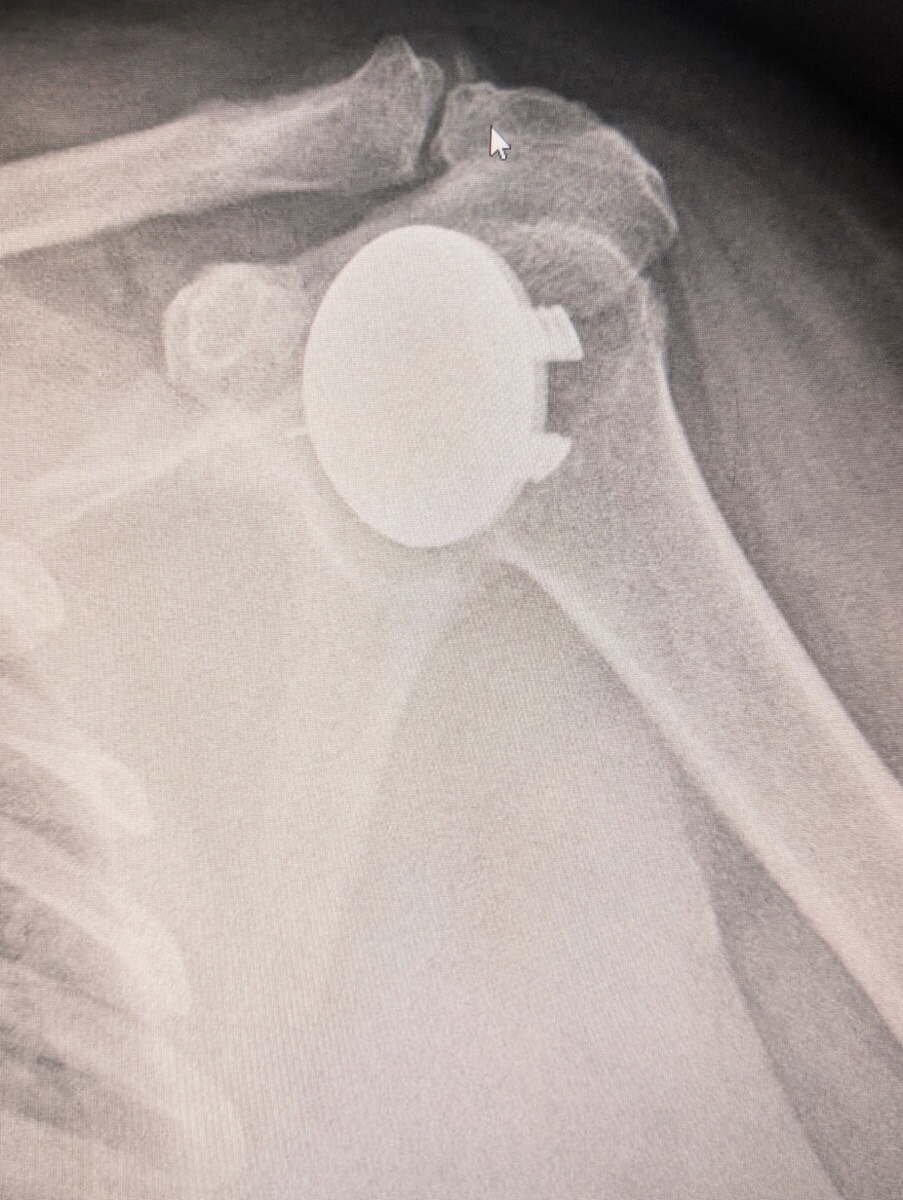
An anatomic stemless shoulder replacement on an X-ray.
Recovery
Protecting the new joint
A sling for about 4 weeks, or up to 6 after a fracture. Gentle exercises from the next day, 3 times a day, while the front tendon heals.
Using the arm again
Most of the early limits are lifted, and the arm can start to take your weight, building up gradually.
Getting stronger
Strengthening, when Dr Malik agrees, starting with a light resistance band.
Back to activities
Swimming, when Dr Malik agrees. If your work involves heavy lifting, from 6 months.
Most of the improvement comes in the first year, and the shoulder can keep improving for up to two years. Many people go back to sports such as golf, swimming and tennis, but some limits stay for life, to protect the new joint. Dr Malik will tell you which apply to you.
The full plan, phase by phase, is on the Anatomic Total Shoulder Replacement recovery page.
What to weigh up
It is a major operation, and like every joint replacement it carries risks. Most people have none of these problems.
The socket lining can loosen
Over many years the plastic lining can work loose. This is the commonest reason for a further operation, and it is more likely with heavy manual work, and in younger people, who have more years of use ahead.
The cuff can wear
The rotator cuff can thin or tear over the years. If it does, the shoulder can usually be changed to a reverse replacement.
The front tendon
The tendon detached to reach the joint occasionally fails to heal, which is why the early limits matter.
Infection
Uncommon, and it usually needs further surgery.
Stiffness or instability
Both are uncommon. Most stiffness settles with exercises; instability can need further surgery.
Nerve injury
Uncommon, and it usually recovers over weeks to months.
Offered when it suits the shoulder and the person
Dr Malik recommends an anatomic replacement when it suits both the shoulder and the person. The health of your rotator cuff and the quality of your bone and joint matter most, more than your age, along with your general health and what you want to get back to.
It often suits
- Osteoarthritis with healthy rotator cuff tendons
- A socket with enough good bone to hold a new lining
- Pain and stiffness that spoil daily life and sleep, despite physiotherapy, painkillers and injections
- Active people, at any age, who want natural movement for work or sport
Another option may be better
- Torn or thin cuff tendons: a reverse shoulder replacement
- A socket too worn, or bone too weak, to hold a lining: usually a reverse replacement
- Pain without much loss of use, or someone not fit for a major operation: physiotherapy, injections and pain relief
Anatomic shoulder replacement FAQs
Long-term studies show that the great majority are still in place, without further surgery, ten years after the operation, and many last longer.
Many people do, once the shoulder has recovered. Swimming can start at 4 to 6 months, and other sports are built up gradually. Some limits stay for life, and Dr Malik will tell you which apply to you.
The new ball sits on a short anchor in the top of the arm bone instead of a stem, which keeps more of your own bone. It needs good-quality bone, and the results are similar to a stem.
Yes. It can usually be changed to a reverse replacement, sometimes keeping the parts in the arm bone.
Yes. You have a general anaesthetic, with a nerve block that numbs the arm for some hours afterwards, so you wake up comfortable.
Dr Malik is trained in the main anatomic shoulder systems, stemmed and stemless, and chooses the parts that suit your shoulder. He explains his choice, and why, before your operation.
Find out whether an anatomic replacement suits you
Bring your X-rays and any scans. Book a consultation at Medanta Hospital, Noida or Medanta Defence Colony.