Home / Robotic Joint Replacement / Direct Anterior Hip Replacement
Direct Anterior Hip Replacement
A hip replacement carried out from the front of the hip, working through a natural gap between muscles rather than detaching them. For the right patient it can mean a quicker, more comfortable start to recovery. Dr Malik trained in the approach in Houston, Texas, and offers it to selected patients.
The same new hip, by a different route
Every hip replacement does the same job: the worn ball and socket are replaced with an artificial joint. What differs is the route the surgeon takes to reach the hip.
The routes used most often come in from the back of the hip (the posterior approach) or from the side (the lateral approach). Both are long established and work very well, but each involves detaching some muscle or tendon from the bone and repairing it at the end of the operation.
The direct anterior approach comes in from the front, through a natural gap between muscles.
Between the muscles, not through them
Picture a slice across the hip, seen from above. Coming from the front, the surgeon passes through a natural gap between two groups of muscles to reach the joint. The side and back routes pass through muscle, and some of it has to be split or detached, then repaired.
On the front route the muscles are still moved aside and stretched, so there is still soreness. But the main muscles stay attached to the bone, which is thought to explain the quicker start many people have.
The new joint itself
The route changes how the surgeon gets to the hip. It does not make it a different kind of hip replacement.
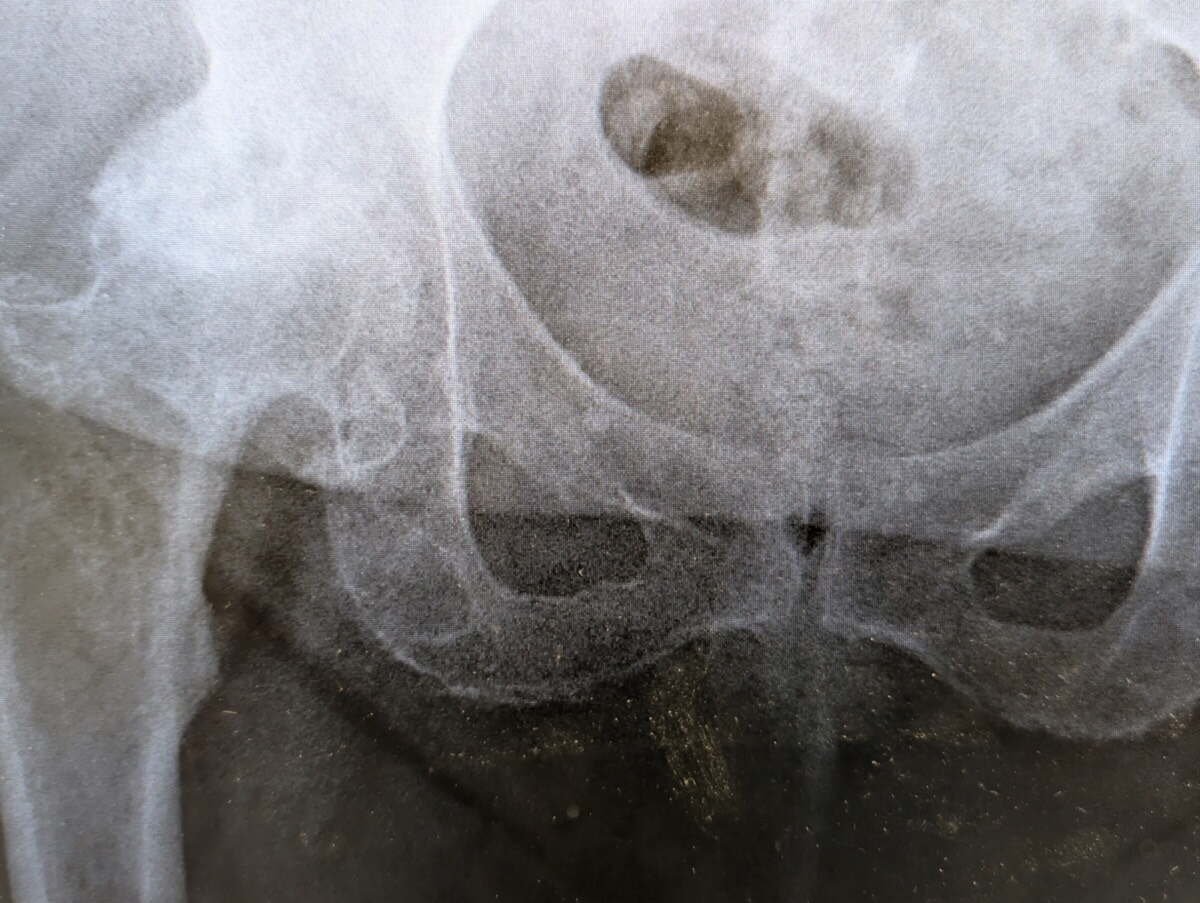
A hip worn by arthritis and avascular necrosis.
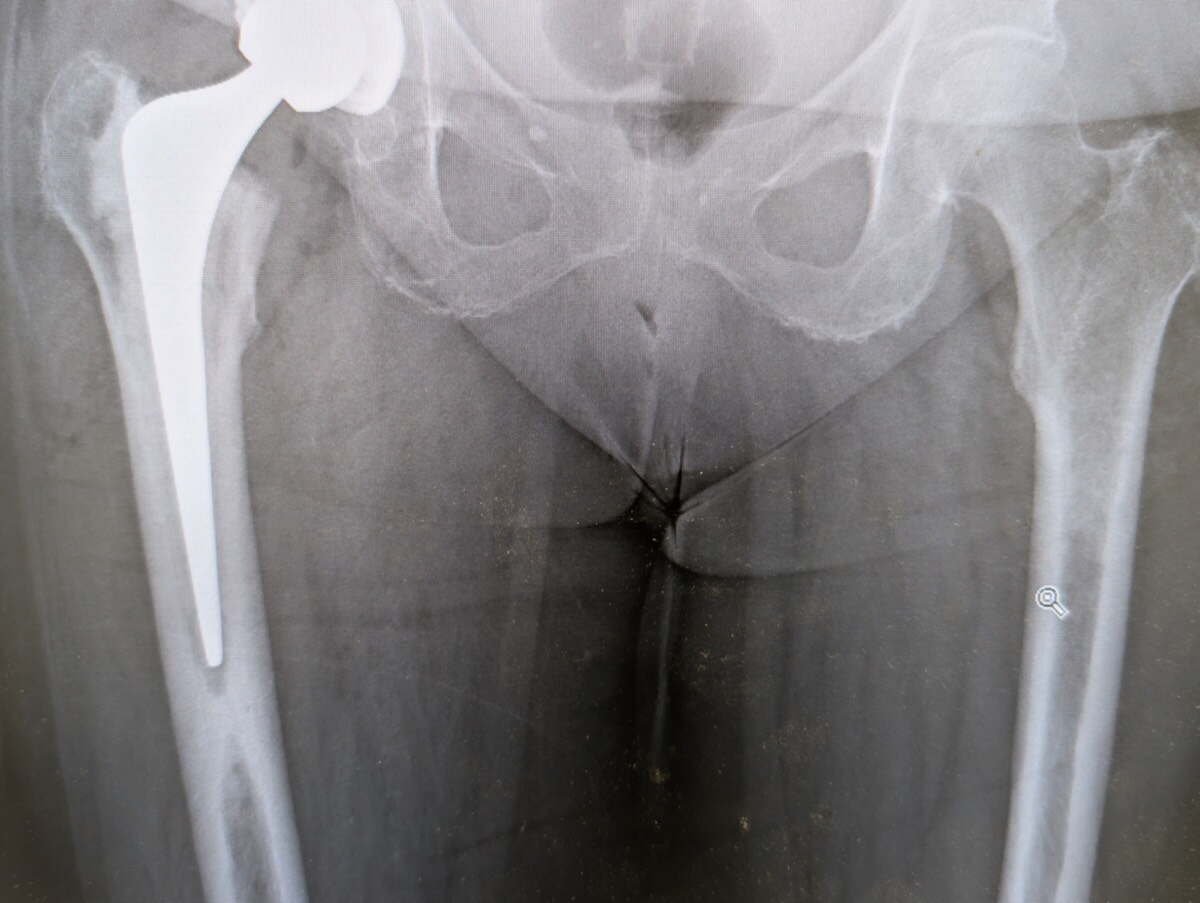
A new hip in place.
The benefits over conventional approaches
These are the advantages it has shown when compared with the routes from the back and the side. They are mostly early ones, and they matter most in the first weeks after your operation.
Less pain in the first days
When the approaches are compared in trials, pain in the first few days after surgery is a little lower with the anterior approach.
Up and about sooner
Many people stop using their walking aids a little sooner, and some go home from hospital a little earlier.
Few restrictions
Because the muscles at the back of the hip are left alone, most people need few, if any, movement restrictions afterwards. You will be told exactly what applies to you.
A stable new hip
Large national joint registries find that hips replaced from the front are less likely to need further surgery for dislocation than hips replaced from the back.
Leg length checked in theatre
You lie on your back, so both legs can be compared directly, and an X-ray in theatre checks the new socket and your leg length before the operation ends.
A scar at the front
The scar runs down the front of the hip, away from where you sit and lie, and is often a little shorter than a traditional one.
The gains are early ones
These advantages show in the first days and weeks. By around six months to a year, people do equally well whichever approach is used, and trials that have followed patients for five years or more find no difference in how the hip works or how long it lasts.
So the anterior approach is about how you get through the early weeks. It is not a promise of a better hip in the long run.
Specialist training in hip replacement and the anterior approach
Dr Malik’s training in hip replacement began with an MCh in Orthopaedics focused on hip and knee reconstruction in the United Kingdom, and continued with a dedicated fellowship in robotic hip and knee replacement in Aberdeen.
In September 2025 he attended the International Masters Anterior Course in Houston, Texas: three days of teaching and cadaveric laboratory sessions devoted to the direct anterior approach, led by surgeons with long experience of it.
He offers the approach to selected patients at Medanta Hospital, Noida and Medanta Defence Colony, alongside conventional and robotic-assisted hip replacement.
- International Masters Anterior CourseHouston, Texas · September 2025
- Robotic Joint Replacement FellowshipAberdeen, United Kingdom
- Certified in robotic-assisted total hip replacementGlasgow, United Kingdom
- MCh Orthopaedics (Hip & Knee)United Kingdom
- British Hip Society Instructional Course and meeting posters2020
- FRCS (Tr&Orth)Royal College of Surgeons of Edinburgh · 2022

With Dr Deepak Gautam and Professor Joseph Moskal at the anterior hip course, Houston.
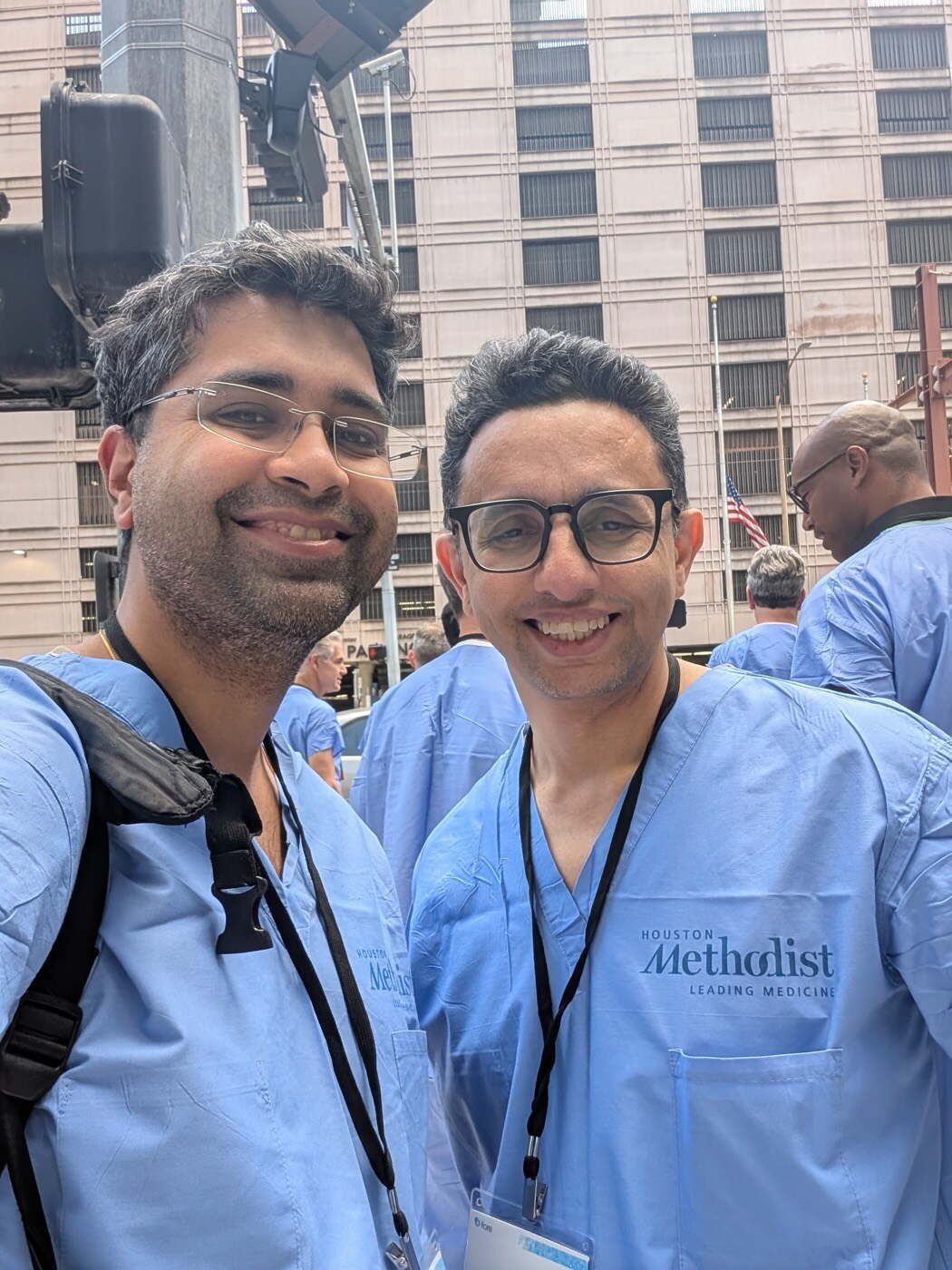
In scrubs for the cadaveric laboratory, Houston.

Receiving the direct anterior approach textbook from its author, Dr Lee Rubin.
What happens in theatre
- You lie on your back on the operating table, under anaesthetic.
- A single cut is made at the front of the hip.
- The surgeon works through the natural gap between the muscles to reach the joint.
- The worn ball and socket are replaced with the new joint.
- An X-ray in theatre checks the position of the new socket and compares your leg lengths before the wound is closed.
- Most people are up and walking with support on the day of surgery or the next day.
How the three approaches compare
| From the frontanterior | From the backposterior | From the sidelateral | |
|---|---|---|---|
| Where the scar sits | Front of the hip | Back of the hip, towards the buttock | Side of the hip |
| How you lie on the table | On your back | On your side | On your side, or sometimes on your back |
| The muscles | Moved aside through a natural gap | Small muscles at the back detached, then repaired | Part of the main muscle at the side detached, then repaired |
| The first days and weeks | Often a little less pain and quicker first steps | A good, steady recovery | A good, steady recovery; the side muscle can take longer, sometimes with a limp |
| Movement restrictions | Usually few | Some surgeons advise precautions early on | Some surgeons advise precautions early on |
| Further surgery for dislocation | Least often | Most often of the three, though still uncommon | Less often than from the back |
| What to watch for | Thigh numbness; wound healing in larger patients; thigh-bone problems | Dislocation | A limp |
| In the right hands | The direct anterior approach has a lesser risk of hip dislocation than the approach from the back, as shown in research papers. | ||
From the front
- Where the scar sits
- Front of the hip
- How you lie on the table
- On your back
- The muscles
- Moved aside through a natural gap
- The first days and weeks
- Often a little less pain and quicker first steps
- Movement restrictions
- Usually few
- Further surgery for dislocation
- Least often
- What to watch for
- Thigh numbness; wound healing in larger patients; thigh-bone problems
From the back
- Where the scar sits
- Back of the hip, towards the buttock
- How you lie on the table
- On your side
- The muscles
- Small muscles at the back detached, then repaired
- The first days and weeks
- A good, steady recovery
- Movement restrictions
- Some surgeons advise precautions early on
- Further surgery for dislocation
- Most often of the three, though still uncommon
- What to watch for
- Dislocation
From the side
- Where the scar sits
- Side of the hip
- How you lie on the table
- On your side, or sometimes on your back
- The muscles
- Part of the main muscle at the side detached, then repaired
- The first days and weeks
- A good, steady recovery; the side muscle can take longer, sometimes with a limp
- Movement restrictions
- Some surgeons advise precautions early on
- Further surgery for dislocation
- Less often than from the back
- What to watch for
- A limp
What to weigh up
Every route has its trade-offs. These are the anterior approach’s own, and they are part of why it is offered to selected patients rather than to everyone.
A numb patch on the thigh
A small skin nerve runs close to the cut. A numb or tingling patch on the outer front of the thigh is common after this approach. It usually improves over the following months, may not go completely, and rarely limits what you can do.
Wound healing
In people carrying extra weight around the tummy and hips, the wound lies close to a skin fold and is more likely to have healing problems.
The thigh bone
Reaching the thigh bone from the front is demanding. National registries show fracture and loosening of the thigh-bone part of the new joint more often after this approach, although both remain uncommon. Careful selection, technique and choice of implant all help.
The usual risks still apply
It is still a hip replacement. Infection, blood clots, a difference in leg length, dislocation, fracture and the possibility of further surgery are risks with any approach.
Offered to selected patients
Dr Malik offers the anterior approach where it suits both the hip and the person. Your X-rays, your build, any earlier surgery and what you want to get back to all come into the decision.
It often suits
- A first hip replacement, for arthritis or avascular necrosis
- A hip of fairly normal shape
- A slim or average build around the hips
Another route may be better
- A lot of weight around the tummy and hips, with a skin fold over the groin
- Earlier surgery on the hip, especially with metalwork still in place
- A re-do (revision) hip replacement
- A badly deformed hip, for example from severe childhood hip dysplasia
- A very muscular build around the hip
If the anterior approach is not the right route for your hip, Dr Malik will recommend another. A well-performed hip replacement through any standard approach gives excellent long-term results, and that matters more than the route.
Not ready for surgery? See Hip Osteoarthritis: exercises and advice.
Direct anterior hip replacement FAQs
In the first weeks it often has small advantages: a little less pain and quicker first steps. By around a year, people do equally well whichever approach is used, and each approach has its own risks. The best choice is the one that suits your hip and your build, in the hands of a surgeon who is comfortable with it.
No. It is an open operation through a single cut at the front of the hip, and the new joint is the same kind of joint. What makes it different is the route between the muscles.
Most people need few, if any. You will be shown how to get in and out of bed, a chair and a car, and told about anything specific to your hip.
A small skin nerve that runs near the cut can be stretched during the operation. It carries feeling from the outer front of the thigh and has nothing to do with movement, so the leg still works normally. The numbness usually improves over months, though a small patch can remain.
Most people go home within a few days. Your own stay depends on your general health and how quickly you are walking safely.
Walking with support begins on the day of surgery or the next day. Many people are off walking aids within a few weeks. Driving usually becomes possible once you can perform an emergency stop comfortably and are off strong painkillers. These are averages rather than promises.
Most people return to walking, swimming, cycling and gym work. Running, jumping and heavy lifting put more load on a new hip, so talk to Dr Malik before going back to them.
Yes, if required. Dr Malik is trained in both, and he will explain what he recommends for your hip at your consultation.
Fees and package costs are available on request, and will be explained in full before anything is scheduled.
Find out whether the anterior approach suits your hip
Bring your X-rays if you have them. Book a consultation at Medanta Hospital, Noida or Medanta Defence Colony.