Home / Shoulder & Elbow / Reverse Total Shoulder Replacement
Reverse Total Shoulder Replacement
A shoulder replacement in which the ball and socket swap places, so that the large deltoid muscle can lift the arm even when the rotator cuff tendons are torn or worn out. Dr Malik plans each operation in 3D, and offers systems from Stryker, Arthrex and Zimmer Biomet, choosing the one that suits your shoulder.
When the cuff can no longer do its job
In a normal shoulder, the ball sits at the top of the arm bone and the socket on the shoulder blade. A group of tendons called the rotator cuff holds the ball in the socket and steers it as the arm moves.
When the cuff is torn beyond repair, or has worn away over the years, the ball rides up and the joint wears out. This is called cuff tear arthropathy. The shoulder becomes painful, and many people can no longer lift the arm. An ordinary shoulder replacement does not work well here, because it still needs a working cuff.
The ball and socket swap places
A reverse replacement swaps the parts over. A metal ball is fixed to the shoulder blade, and a cup to the top of the arm bone. This gives the shoulder a fixed pivot, so that the deltoid, the large muscle over the shoulder, can lift the arm without the cuff.
When a reverse replacement is used
Arthritis with a torn rotator cuff
Cuff tear arthropathy, the commonest reason.
A large cuff tear that cannot be repaired
When you can no longer lift the arm. Physiotherapy comes first, and many people manage without an operation.
A badly broken shoulder in an older person
When the top of the arm bone is in several pieces.
Arthritis with a badly worn socket
Often in older people, even when the cuff is intact.
Rheumatoid and other inflammatory arthritis
When the joint and the cuff are both damaged.
A failed earlier operation
A shoulder replacement or fracture repair that has not worked, or a shoulder that has been dislocated for a long time.
Not ready for an operation? See the Deltoid Retraining Programme.
What the results show
Reverse shoulder replacements are followed by national joint registries in several countries, and by long-term studies. This is what they show for the operation in general.
Lasting pain relief
Pain relief is the most dependable benefit. Studies that have followed people for ten years and more find that, for most, the pain stays away.
The arm working again
Most people can lift the arm well above shoulder height after the operation, even if they could barely lift it before.
Built to last
National joint registries show that the great majority of reverse shoulder replacements are still working well, without further surgery, ten years after the operation.
Most are pleased
The great majority of people are satisfied with the result, and in long-term studies most say they would have the operation again.
Back to gentler sport
Most people return to gentler sports, such as golf and swimming.
For broken shoulders
In older people with a badly broken shoulder, a reverse replacement gives more reliable use of the arm than the older half-replacement.
These findings come from national joint registries and large published studies, not from one surgeon’s own results. Results are less predictable after earlier shoulder surgery or an old fracture, and in younger, very active people.
Grammont and lateralised designs
The first successful reverse shoulder was designed in France in the 1980s by Professor Paul Grammont. His idea was to move the pivot of the shoulder inwards, close to the shoulder blade, and downwards. That gives the deltoid a strong lever to lift the arm and makes a very stable joint, and it is still the basis of every reverse shoulder today.
It has two known weak points. The arm part can rub on the bone of the shoulder blade just below the ball, leaving a wear mark on X-rays called notching. And turning the arm outwards, for example to brush your hair, is often limited.
Lateralised designs move the pivot outwards again, on the shoulder-blade side, the arm side, or both. This reduces notching, often helps turning the arm outwards, and gives a rounder, more natural shoulder shape. The trade-off is more load on the baseplate’s fixation and on the bone at the top of the shoulder.
| Grammont-stylepivot drawn in | Lateralisedpivot moved out | |
|---|---|---|
| Where the pivot sits | Close to the shoulder blade | Further out |
| Lifting the arm | Good | Good |
| Turning the arm outwards | Often limited | Often a little better |
| Notching on X-rays | Common | Much less common |
| Shape of the shoulder | Can look flatter | Rounder, closer to normal |
| Load on the baseplate and the acromion | Lower | Higher, kept in check by design and planning |
| Overall results | Good | Good, and similar |
Grammont-style
- Where the pivot sits
- Close to the shoulder blade
- Lifting the arm
- Good
- Turning the arm outwards
- Often limited
- Notching on X-rays
- Common
- Shape of the shoulder
- Can look flatter
- Load on the baseplate and the acromion
- Lower
- Overall results
- Good
Lateralised
- Where the pivot sits
- Further out
- Lifting the arm
- Good
- Turning the arm outwards
- Often a little better
- Notching on X-rays
- Much less common
- Shape of the shoulder
- Rounder, closer to normal
- Load on the baseplate and the acromion
- Higher, kept in check by design and planning
- Overall results
- Good, and similar
There is no single best design. Each has strengths and trade-offs, and most modern operations sit somewhere between the two. The balance is chosen for each shoulder.
Three ways to move the pivot out
Planned for your shoulder, not a standard set-up
Shoulders differ in the shape and wear of the socket, the quality of the bone, the cuff tendons that are left, and what each person wants to do with the arm. Dr Malik plans every reverse replacement around these. He generally uses a lateralised set-up, with the arm part at 135°, and chooses for each shoulder:
- how far out the pivot sits, and whether it is moved on the shoulder-blade side, the arm side, or both;
- the size of the ball, and its position low on the socket to avoid notching;
- a wedge-shaped (augmented) baseplate or a bone graft when part of the socket has worn away;
- the length of the stem, and whether it is fixed with or without bone cement;
- which of the systems suits the shoulder.
When part of the socket has worn away
Your operation is planned in 3D
Planning in 3D helps the parts go where they were planned, with fewer ending up off target. It is a tool, not a substitute for judgement. Dr Malik checks every plan himself, and adjusts it in theatre if the bone or soft tissues call for it.
The systems Dr Malik uses
Dr Malik offers reverse shoulder systems from three manufacturers, and chooses between them according to what each shoulder needs.
Tornier Perform, planned with Blueprint
The Tornier Perform reverse shoulder, with baseplates in standard and wedge-shaped (augmented) forms for a worn socket, and lateralised options.
Planned with Blueprint 3D software, which can also make a guide to fit your bone.
Univers Revers, with the Modular Glenoid System, planned with VIP
The Univers Revers shoulder, with the Modular Glenoid System’s baseplates in standard and wedge-shaped (augmented) forms.
Planned with Arthrex’s Virtual Implant Positioning (VIP) software, with a VIP guide made to fit your bone. Dr Malik has trained in its use, and sets the arm part at 135°.
Comprehensive Reverse Shoulder
The Comprehensive reverse shoulder, with baseplates in several sizes and shapes, including wedge-shaped (augmented) forms.
Dr Malik uses it when a shoulder calls for it.
Dr Malik is also trained in the Delta Xtend reverse shoulder from DePuy Synthes, a Grammont-style design.
The make of implant is one part of the plan, and Dr Malik explains his choice before your operation.
International training in shoulder replacement
Dr Malik trained in shoulder replacement through two consecutive 12-month shoulder and elbow fellowships in dedicated upper-limb units in Manchester and North Tees, United Kingdom. They covered shoulder replacement and complex repeat (revision) surgery, and followed his FRCS (Tr&Orth) in Edinburgh. He was appointed Senior BOA National Fellow in Upper Limb Surgery.
He trained further on travelling fellowships at the Mayo Clinic in Rochester, USA, with Professor Joaquin Sanchez-Sotelo, and at the ICR in Nice, France, in June 2023, the city where the BIO-RSA bone-graft technique was developed. He returns to Nice for a further month in early 2027.
He offers reverse shoulder systems from Stryker, Arthrex and Zimmer Biomet at Medanta Hospital, Noida and Medanta Defence Colony, and plans each operation in 3D.
- Travelling Fellowship, Mayo ClinicRochester, USA · 2026
- Travelling Fellowship, ICRNice, France · June 2023
- Nice Shoulder CourseNice, France · June 2024
- Arthrex Shoulder Fellows Forum2024
- Cutner Travelling Fellowship GrantRoyal College of Surgeons of Edinburgh · 2025–26
- Copeland Fellowship GrantBritish Elbow & Shoulder Society · 2024
- Double Shoulder & Elbow FellowshipManchester and North Tees, United Kingdom
- Senior BOA National FellowUpper Limb Surgery
- FRCS (Tr&Orth)Royal College of Surgeons of Edinburgh · 2022
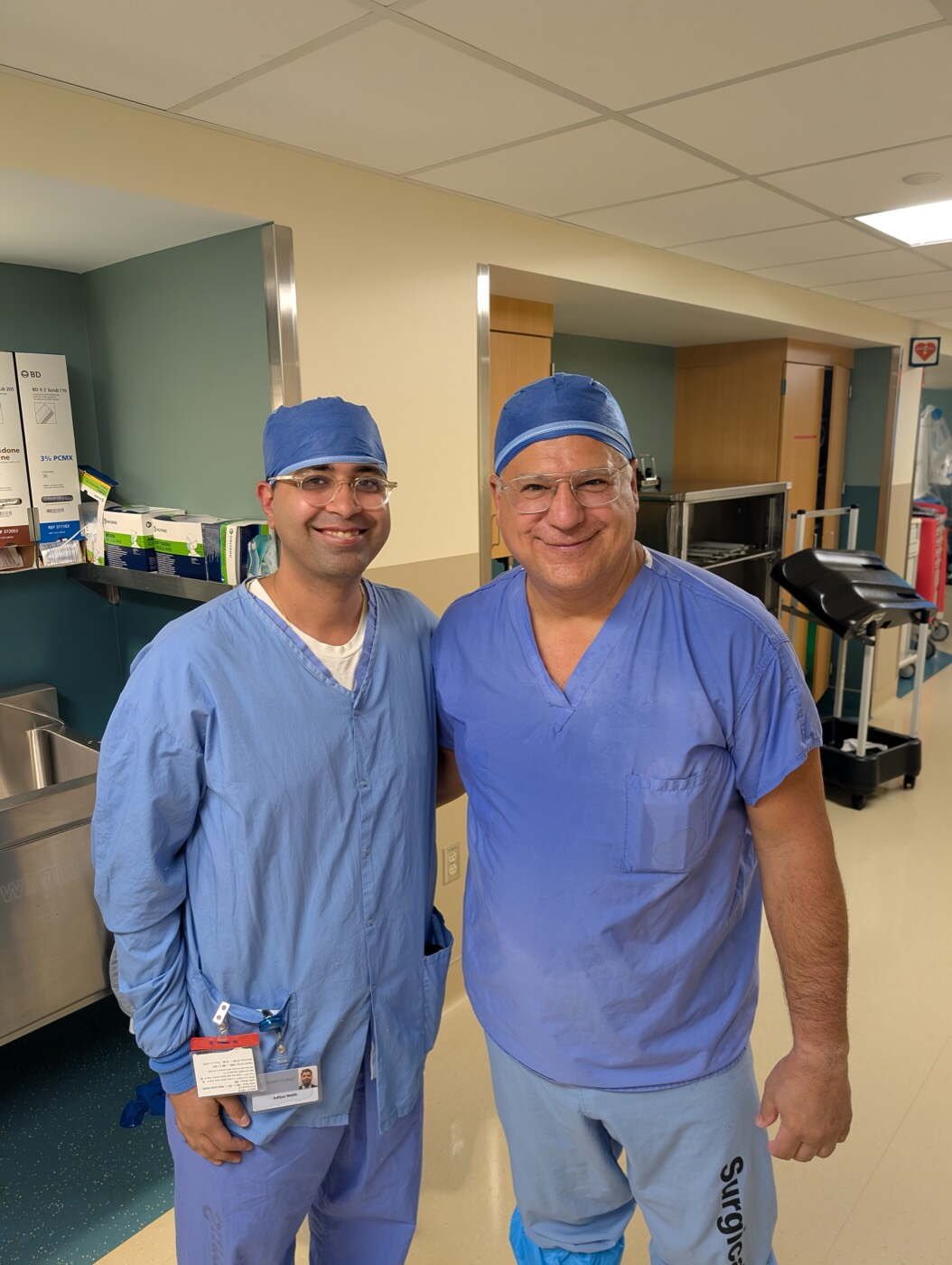
In theatre scrubs with Professor Joaquin Sanchez-Sotelo at the Mayo Clinic.
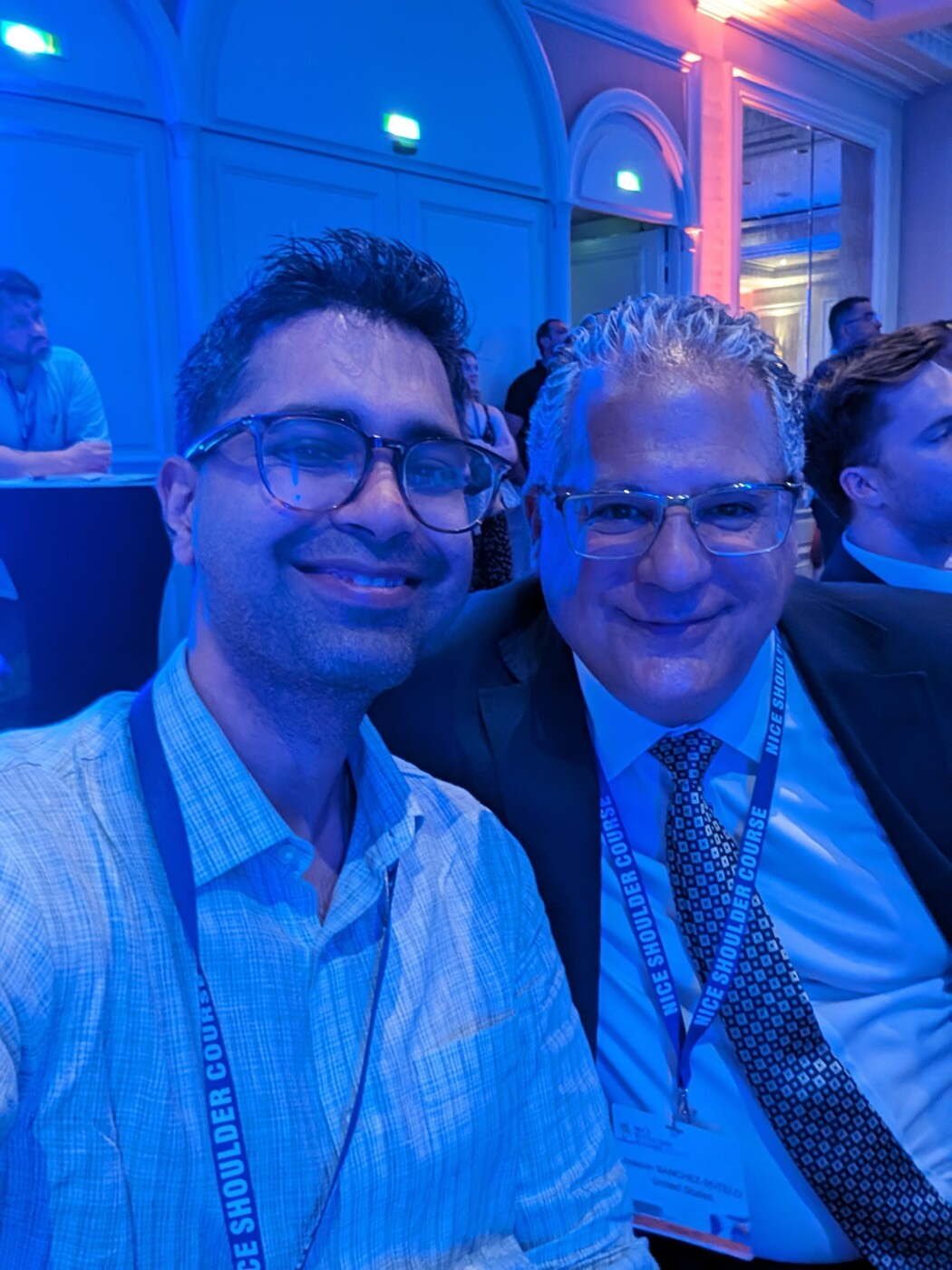
With Professor Sanchez-Sotelo at the Nice Shoulder Course, June 2024.
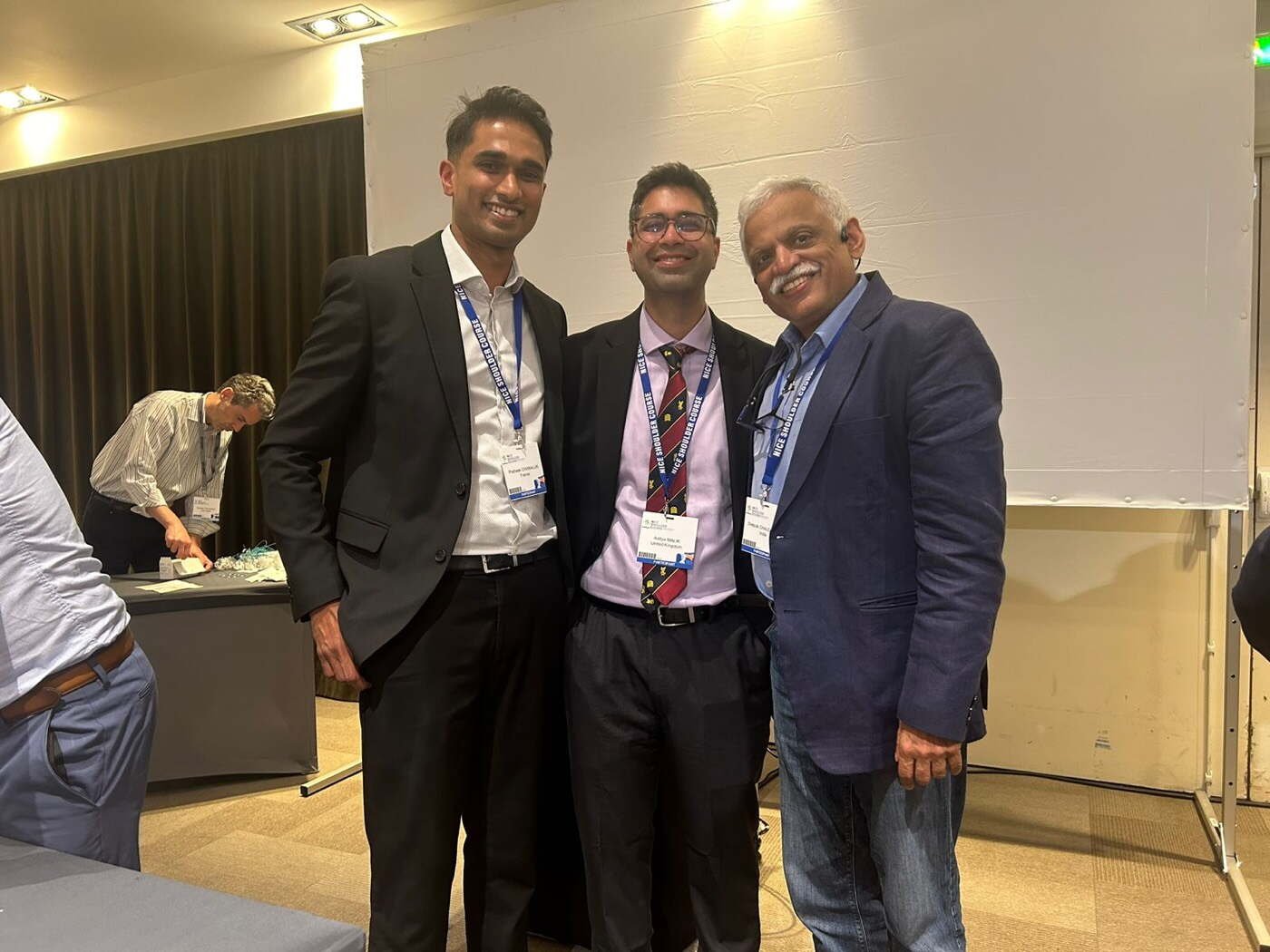
With Dr Prateek Chikkalur and Dr Deepak Joshi at the Nice Shoulder Course, 2024.

The Arthrex facility in Solihull, where he attended cadaveric shoulder and elbow labs.
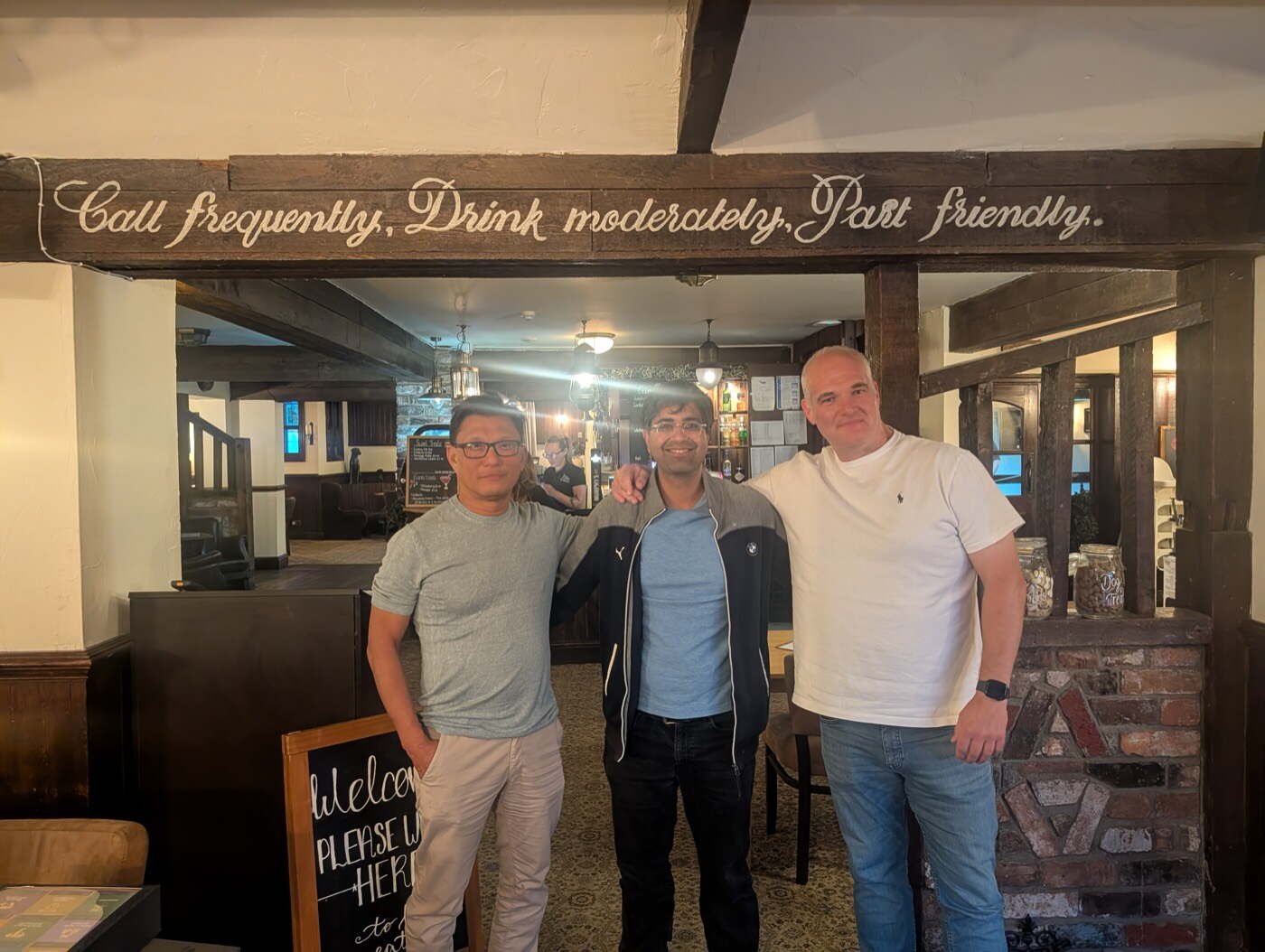
With his fellowship trainers, Mr Richard Jeavons and Mr Raymond Liow, at North Tees.
What happens in theatre
- You have a general anaesthetic, with a nerve block that numbs the arm for some hours afterwards.
- A cut is made at the front of the shoulder. A tendon at the front of the shoulder is usually detached to reach the joint, and repaired at the end.
- The worn ball is removed, and the socket is prepared following the 3D plan, or the guide made for your bone.
- The baseplate is fixed to the socket with screws, and the metal ball is attached to it.
- The arm part is fitted, the joint is put together and checked for movement and stability, and the wound is closed.
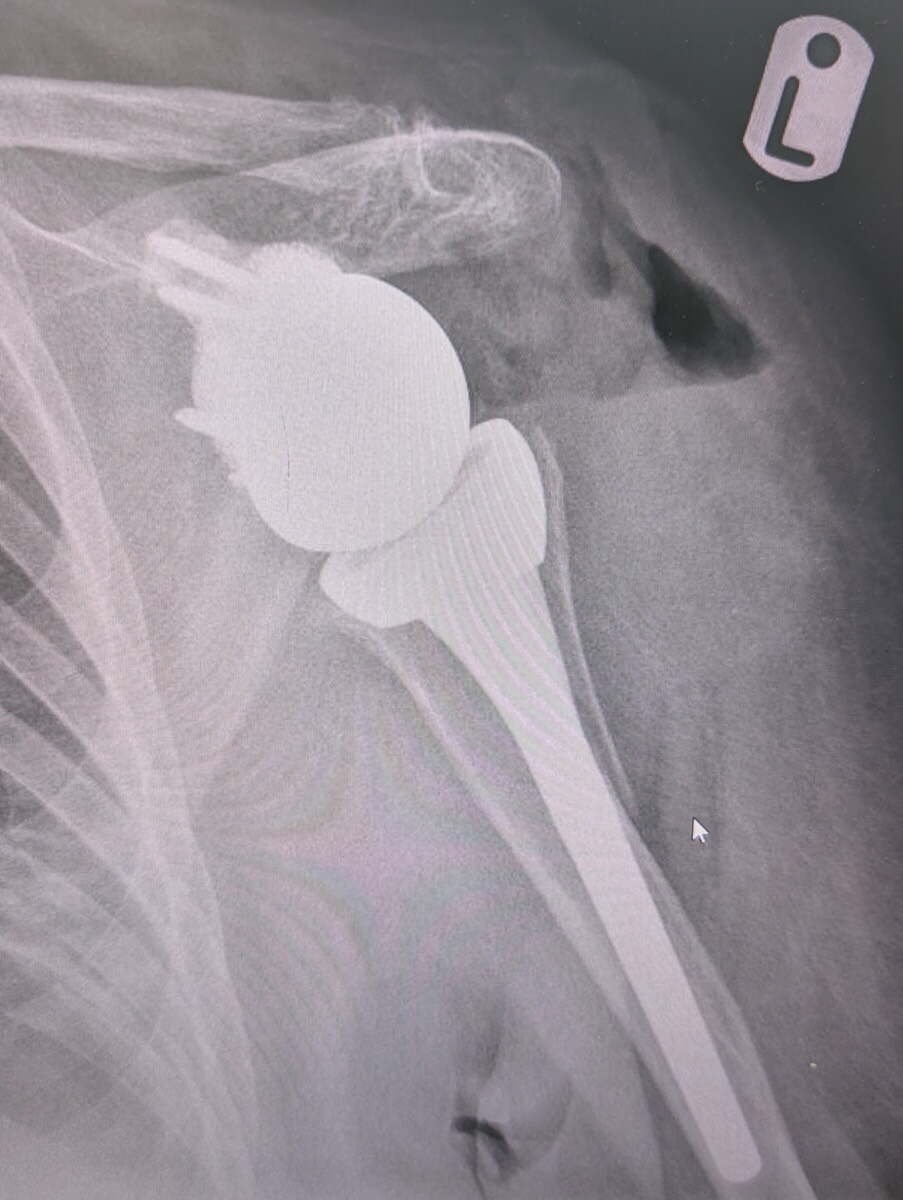
A reverse shoulder replacement on an X-ray.
Recovery
Protecting the new joint
A sling for about 4 weeks, or up to 6 after a fracture or a repeat operation. Gentle exercises from the next day, 3 times a day.
Using the arm again
Light tasks at waist height. No weight on the arm, such as pushing up from a chair.
Getting stronger
Strengthening, and the arm can take your weight.
Back to activities
Gentle swimming. If your work involves heavy lifting, from 6 months.
In the long term, golf is usually the most demanding sport to go back to. Heavier sports, such as racket and contact sports, and heavy weights put too much strain on the new joint.
The full plan, phase by phase, is on the Reverse Total Shoulder Replacement recovery page.
What to weigh up
It is a major operation, and like every joint replacement it carries risks. Most people have none of these problems.
Infection
Uncommon. It is more common in men and after a repeat operation, and it usually needs further surgery.
Dislocation
Uncommon, and most likely in the first weeks. It is more common after a fracture or a repeat operation, which is why the early limits matter.
A stress fracture at the top of the shoulder
The deltoid now works harder, and occasionally the bone at the top of the shoulder (the acromion) cracks under the load, more often when the bone is thin. Most are treated with rest in a sling, but the shoulder may not end up working quite as well.
Nerve injury
Uncommon, and it usually recovers over weeks to months.
Reaching behind your back
It often stays limited, for example tucking in a shirt or washing your back. Most people manage with small changes.
Further surgery
Some people need a further operation over the years, more often younger, very active people and men. A wear mark (notching) often shows on X-rays over time; it usually causes no symptoms.
Offered when it suits the shoulder and the person
Dr Malik recommends a reverse replacement when it suits both the shoulder and the person. Your X-rays and CT scan, your cuff, your bone, your general health and what you want to get back to all come into the decision.
It often suits
- Arthritis with a torn or worn-out cuff
- A large cuff tear that cannot be repaired, when physiotherapy has not helped
- A badly broken shoulder in an older person
- A failed earlier shoulder operation
Another option may be better
- An intact cuff, with a socket that has good bone to hold a new lining: an anatomic shoulder replacement, which keeps the normal ball and socket
- A cuff tear that can still be repaired: keyhole (arthroscopic) repair
- Pain without much loss of use, or someone not fit for a major operation: physiotherapy, injections and pain relief
- A damaged deltoid muscle or its nerve: a reverse replacement relies on the deltoid
Reverse shoulder replacement FAQs
National joint registries show that the great majority are still working well ten years after the operation, and many last longer.
Most people can lift it well above shoulder height. Reaching behind the back is often limited.
Most people can. Gentle swimming starts from about four months, and golf once Dr Malik is happy with your strength. Golf is usually the limit in the long term.
No. It is an open operation through a cut at the front of the shoulder.
Yes. You have a general anaesthetic, with a nerve block that numbs the arm for some hours afterwards, so you wake up comfortable.
Dr Malik offers systems from Stryker, Arthrex and Zimmer Biomet, and chooses the one that suits your shoulder. He explains his choice, and why, before your operation.
Find out whether a reverse shoulder replacement suits you
Bring your X-rays and any scans. Book a consultation at Medanta Hospital, Noida or Medanta Defence Colony.